
Nikro Air Duct Cleaning in Carson: A Homeowner’s Guide
Nikro air duct cleaning in Carson uses negative-air machines built by Nikro Industries, a supplier to industrial hygienists and HVAC remediation contractors. It’s not the kind of gear you’ll find bolted into a discount cleaning van. Here’s what those machines actually do, why the equipment matters more than the brand sticker, and how to tell whether a contractor is running real Nikro hardware or just borrowing the name for credibility. If you’d rather skip the homework and just want the ducts done right, call (866) 569-6170.
Why Nikro Equipment Shows Up on Professional Rigs, Not Coupon Trucks
Nikro Industries has spent decades building air-moving and filtration equipment for a specific customer: contractors who clean up after fires, floods, mold, and industrial contamination. Their machines are designed to run for hours at a stretch, hold HEPA filtration that won’t bypass under load, and move enough cubic feet per minute to pull debris out of duct runs without redepositing it in the living room. When a Carson homeowner sees a Nikro unit on a truck, it’s usually a sign the operator invested in equipment that costs several times what a portable consumer vacuum runs.
The distinction matters. A standard residential duct cleaning setup often uses a truck-mounted vacuum or a repurposed shop vac with a long hose. That works for surface dust in short, straight duct runs. It struggles with the kind of buildup common in Carson homes near the 405 and 110 corridors, where fine particulate from traffic, older construction dust, and decades of accumulated debris sit deep in return lines and flex duct. Nikro’s negative-air approach puts the HEPA filter at the collection unit, not at the hose nozzle, which changes how thoroughly a system can be cleaned. We run both Air Duct Cleaning in Manhattan Beach and Carson jobs with this in mind, because the same logic applies across the South Bay’s older housing stock.
How Nikro’s Negative-Air System Works (and Why It Prevents Re-Contamination)
The core idea is simple: instead of pushing air and debris around, a negative-air machine puts the duct system under vacuum. The Nikro unit connects to the ductwork and pulls air through it continuously while cleaning tools agitate the interior surfaces. Debris that breaks loose gets carried by airflow toward the collection point, not blown back into the house.
The HEPA filtration at the unit level is the part homeowners in Carson should care about. HEPA filters, when properly seated and maintained, capture 99.97% of particles down to 0.3 microns. That includes the fine dust, pollen, and particulate that settles into ducts and recirculates when the HVAC system runs. If a cleaning setup uses a standard filter or no filtration at the collection point, it’s essentially moving dust from the ducts into the air you breathe during the job. We’ve walked into homes in Carson where a previous cleaning left more dust on the furniture than was in the registers to begin with. That’s what happens when the equipment isn’t built for containment.
Abatement Technologies negative-air systems work on the same principle and appear in mold remediation and hospital construction environments. The category matters more than any single brand. What a homeowner should ask is whether the equipment maintains negative pressure for the full duration of the cleaning and whether the HEPA filter is changed or inspected between jobs. A contractor who can answer those questions without blinking is operating at a different tier than one who shows up with a vacuum and a brush.
Rotary Brushes vs. Air Whips: What Actually Cleans Carson Ductwork
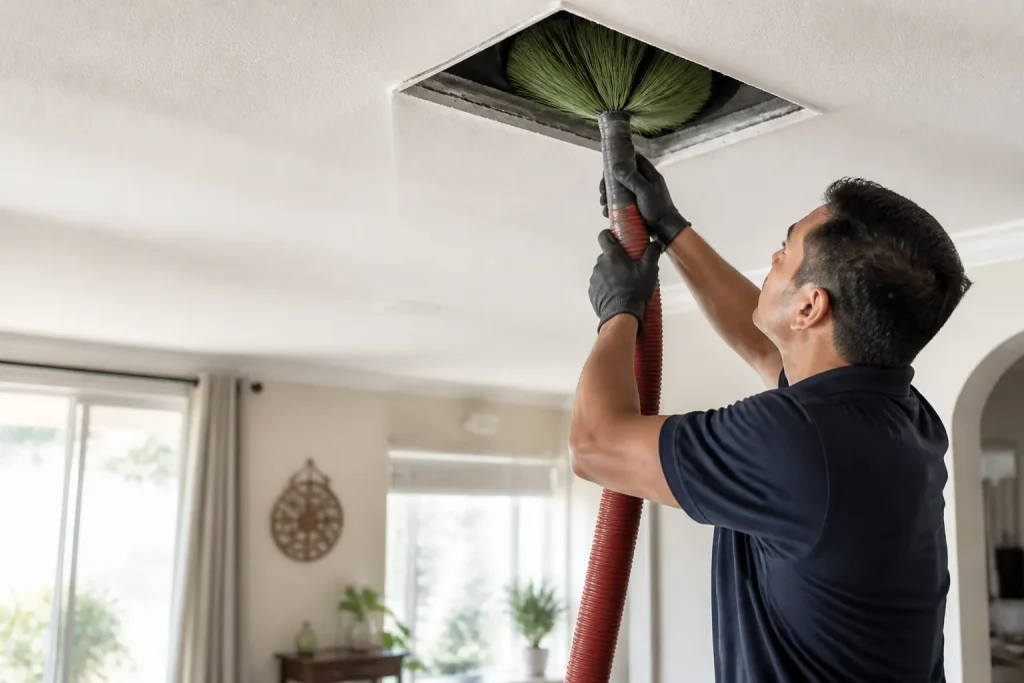
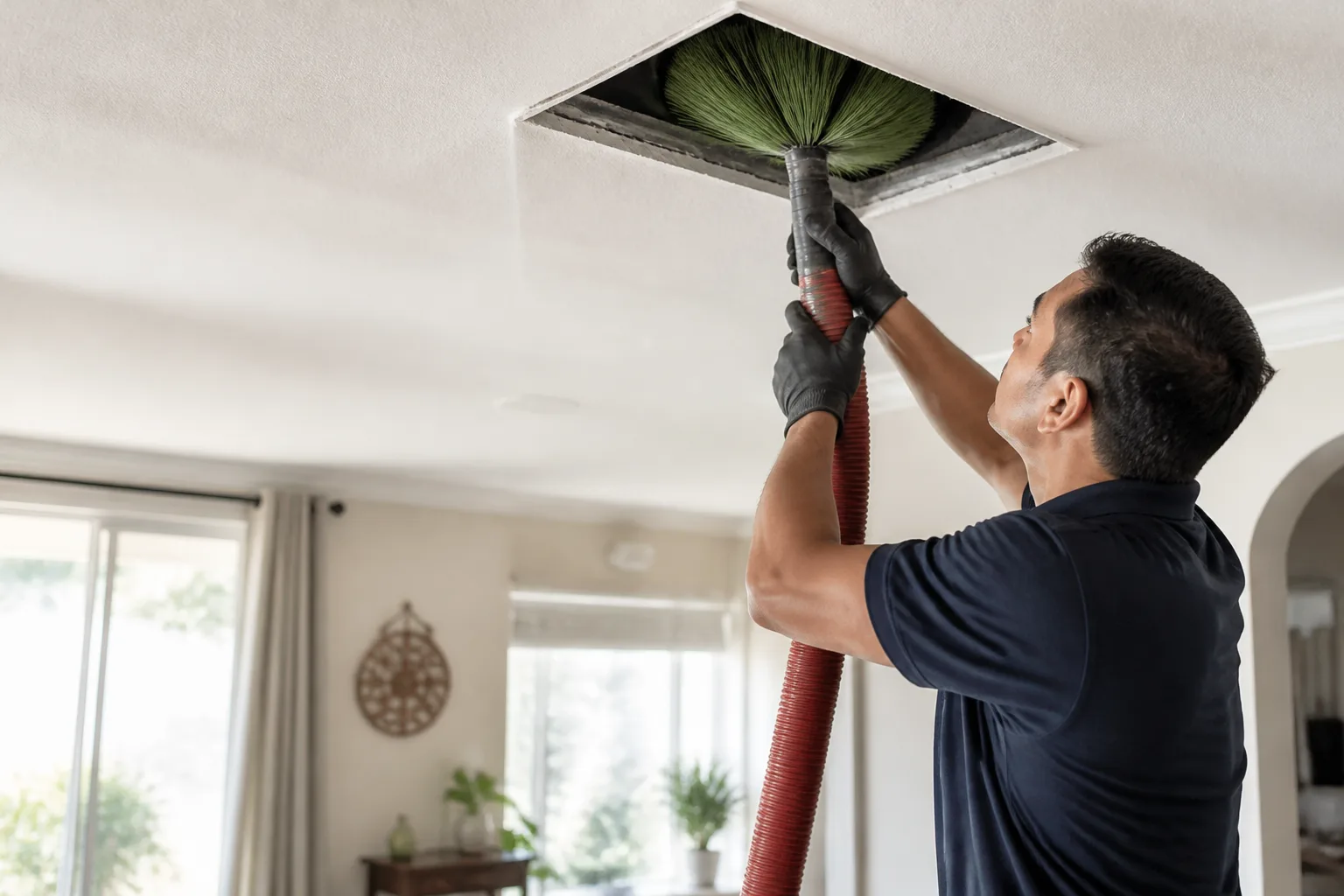
Nikro builds two main categories of agitation tools that get paired with their negative-air machines: rotary brush systems and air whip systems. They do different jobs, and understanding the difference helps you evaluate what a contractor is actually planning to do in your home.
Rotary brush systems use a motorized brush head that spins inside the duct, scrubbing the walls as it travels. They’re effective on rigid sheet metal ducts, which are common in older Carson homes built before flex duct became standard in the 1980s and 1990s. The brush physically scrapes off caked dust, cigarette residue from decades ago, and the kind of greasy film that accumulates in kitchens. Rotary brushes require careful speed control, because an aggressive brush on damaged or thin metal can cause more harm than good.
Air whips, by contrast, use compressed air delivered through a nozzle that whips around inside the duct, dislodging debris with air pressure instead of contact. They’re gentler on flex duct and work well in systems where the duct material is aging or already showing signs of separation. In Carson’s older housing stock, we regularly see flex duct that’s brittle, sagging, or partially collapsed. That’s exactly where an air whip makes sense: it loosens debris without tearing the inner liner that a rotary brush might catch on.
The question to ask a contractor is simple: “Which agitation method do you use on flex duct versus sheet metal, and how do you decide?” A professional will have a clear answer. A blow-and-go crew will look at you like you asked them to explain quantum physics.
Why Equipment-Grade Matters in Older Carson Homes
Carson’s residential development spans several eras. Homes built in the 1950s and 1960s often have original sheet metal ducts that are sturdy but coated in decades of buildup. Homes from the 1980s forward frequently used flex duct, which degrades over time. Flex duct has an inner liner that can tear, separate from the outer insulation, or collapse when the wire coil loses tension. Aggressive cleaning on deteriorated flex duct can turn a dirty system into a damaged one.
This is where the equipment conversation stops being academic. A contractor running the right tool for the material, with the air volume matched to the duct size, gets the debris out without accelerating deterioration. A contractor running one tool on everything, at max speed, creates problems you’ll find later as uneven airflow or higher energy bills.
We field calls from Carson homeowners who had a “cleaning” done and came away with a new problem: a room that suddenly doesn’t get airflow, a register that whistles, a duct that’s visibly sagging in the attic. When we open those systems up, we often find flex duct that was separated by a brush that had no business being in there, or a connection that was loose before the cleaning and got pushed apart by the agitation. Our Air Duct Repair in Manhattan Beach service exists because we kept encountering this. The same repair capability matters in Carson, where finding a separated duct joint mid-cleaning means fixing it on the spot instead of scheduling a second vendor and living with leaks for another two weeks.
How to Verify a Contractor Is Actually Running Nikro Equipment
Anyone can put “Nikro” on a website. A surprising number of cleaning companies name-drop equipment brands they don’t own, betting that homeowners won’t know the difference. Here’s how to check without being confrontational about it:
- Ask for the model number. Nikro makes specific units like the WS-4423 and others with defined CFM and filtration specs. A contractor who runs the equipment can tell you the model off the top of their head. One who says “the big one” or “our truck system” is telling you something useful.
- Look for the unit on the truck. Nikro negative-air machines are not small. They’re floor-standing units with visible filtration housings. If the crew shows up with two handheld vacuums and a garden hose attachment, no amount of brand talk matters.
- Ask about CFM and your duct linear footage. This is the cross-reference that separates professionals from pretenders. A negative-air system needs to move enough air volume to maintain velocity through the full length of your duct runs. Rough rule of thumb: know your approximate linear duct footage, and ask whether the unit they’re running is sized for it. We’ve seen systems rated at 2,000 CFM doing fine on a 1,200-square-foot Carson ranch with 60 feet of main trunk. Put that same unit on a 3,000-square-foot two-story with 150 feet of branching returns and you’re underpowered. The contractor should be able to explain the match.
- Ask about filter change frequency. HEPA filters have a finite life and cost real money to replace. A contractor who won’t discuss filter replacement schedule or inspection between jobs likely isn’t maintaining the equipment properly.
None of these questions are impolite. They’re exactly what a homeowner should ask before someone runs machinery through the walls of their house. When we talk to Carson customers about equipment, we volunteer this information before they ask, because a homeowner who understands the job we’re doing is a better customer than one who’s wondering whether they’re being taken for a ride.
What Nikro Equipment Surfaces in Carson Duct Systems
Carson’s location does specific things to ductwork. Homes near the 405, the 110, and the refineries on Del Amo contend with particulate that settles faster and finer than what you’d find in coastal cities with steady ocean breezes. Add the Santa Ana winds that kick up dust from the inland valleys, and duct systems accumulate a fine, gritty layer that embeds into flex duct lining. A standard cable-and-brush rig will push some of that around. A negative-air system with a properly sized HEPA filter will pull it out.
We’ve also seen the results of years of deferred maintenance in Carson homes where the HVAC filter wasn’t changed regularly. When the filter at the return grille is clogged, air bypasses around the filter frame and pulls unfiltered air directly into the system. That deposits dust throughout the supply lines, not just in the return. The fix is a proper cleaning with equipment that can move enough air to dislodge and capture what’s sitting in those supply branches.
Key Takeaways for Carson Homeowners
- Nikro equipment is built for remediation contractors, not residential coupon crews. Its presence signals a different tier of operator.
- Negative-air cleaning with HEPA filtration at the unit prevents re-contamination during the job. Filtration location matters.
- Rotary brushes handle sheet metal; air whips handle flex duct. The right tool depends on your home’s duct material and condition.
- Older Carson flex duct can be damaged by aggressive cleaning. Ask how your contractor matches tools to materials.
- Verify equipment claims by asking for model numbers, CFM ratings, and filter change practices before the crew starts.
When to Call a Pro
If you’re reading this because you suspect your ducts are affecting air quality or you’ve had a previous cleaning you weren’t confident about, a professional inspection is the right next step. The equipment conversation matters because the tooling determines the outcome, but you shouldn’t have to become an HVAC engineer to get your ducts cleaned properly. A reputable contractor will answer the equipment questions in plain language, show up with the machinery they advertised, and document the before-and-after condition so you can see what was actually removed.
We pulled a flex duct liner out of a garage conversion in Carson last month that had collapsed so completely it was moving maybe twenty percent of the air it should have. The homeowner said the previous cleaning company never mentioned it. That’s not a cleaning failure, exactly, but it’s a failure of inspection, and it’s why we treat every job as a system assessment first.
For related services in Carson, our Dryer Vent Cleaning in Manhattan Beach service applies the same thoroughness to the exhaust line, which presents a documented fire risk when lint accumulates. And for systems where age has taken a toll beyond what cleaning can address, Air Duct Repair in Manhattan Beach covers leaks, separations, and damage found during the job.
The Bottom Line
Nikro equipment isn’t a brand most Carson homeowners will ever shop for directly. It’s a signal. When a contractor runs Nikro negative-air machines with proper HEPA filtration, they’ve made a capital investment that cheap crews won’t make. When they pair those machines with the right agitation tools for the duct material in your home, they’re doing a different job than what a portable vacuum can accomplish. The way to protect yourself is to ask specific questions about equipment, CFM, and methodology, and to expect clear answers. If you’re in Carson and want a system assessment with equipment that does what the name implies, Duct Cleaning Carson home offers free estimates. Call (866) 569-6170 and we’ll walk you through what we run, why we run it, and what we’d do in your specific system.
Frequently Asked Questions
No. Nikro is one brand among several that produce professional-grade negative-air and agitation equipment. What matters is the category of equipment and how it’s used: negative-air pressure with HEPA filtration, appropriate agitation tools for the duct material, and enough CFM for the system’s size. Nikro is a reliable indicator that a contractor operates at that tier, but it’s not the only brand that gets the job done. Rotobrush and other manufacturers also build professional systems.
Professional duct cleaning with contractor-grade equipment in Carson typically ranges from $450 to $1,200 for a full system, depending on home size, number of returns, duct condition, and accessibility. Homes with extensive flex duct damage or multiple systems will run higher. Be wary of prices under $200 for the whole house; that usually means a surface-level job with inadequate equipment. Our estimates are free, and we give one flat price per system before work starts. Call (866) 569-6170 for an exact quote.
Ask for before-and-after photos or video of the duct interior, specifically the return lines and supply branches where buildup concentrates. A professional with negative-air equipment should be able to document the condition before agitation begins and after debris has been extracted. If a contractor can’t show you the interior of your ducts at any point during the job, that’s a red flag. We photograph the system during inspection and again at completion so you can see what came out and what the surfaces look like afterward.
Yes, and it happens more often than it should. Older flex duct with brittle inner liners or weak wire coils can tear or separate when a rotary brush is run through it at speed. A professional contractor will assess duct material before choosing agitation tools and will switch to an air whip or reduce brush speed on flex duct that shows signs of deterioration. The right equipment for the specific duct material in your home is as important as the brand name on the machine.
Written by the team at Duct Cleaning Carson, serving Carson since 2011.
Need Air Duct Cleaning Help?
Call Duct Cleaning Carson - licensed & insured, here with fast help in Carson.
(866) 569-6170